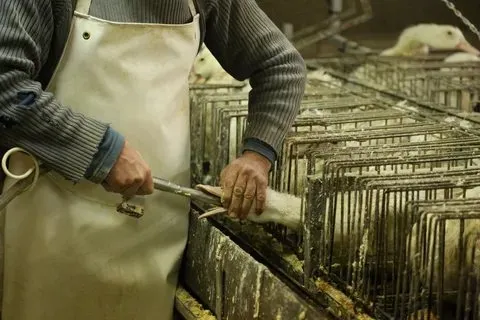
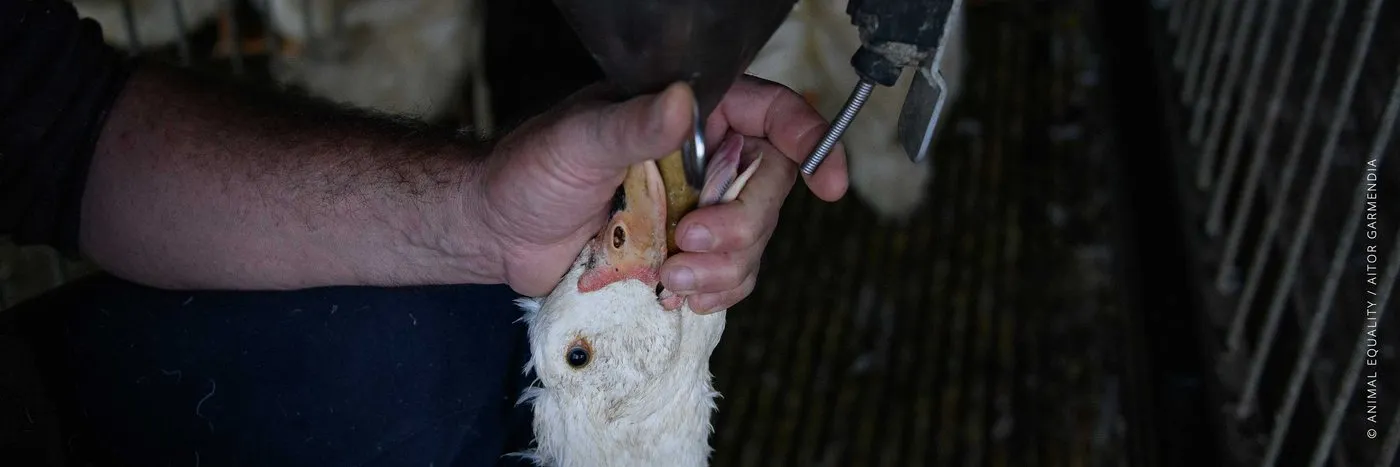
The name means fatty liver. It is produced by pushing a tube down a bird's throat until the organ swells.
Gavage is a short procedure repeated many times, and the repetition is the method. The same kind of tube is legitimate clinical equipment elsewhere; here it serves a different purpose, which is not keeping a sick animal alive but swelling a healthy organ into a product.
About 3 min · 3 steps · you control the pace
Use ← and → to move, Esc to exit
1 The bird is held
Foie Gras Gavage
A bird is gripped and held still, one of many times it will be restrained during the finishing period.
What this is
A tube is pushed down the bird's throat and a measured amount of feed is delivered into the upper digestive tract. This is repeated through the finishing period.
Why the system uses it
The product is an enlarged liver. Gavage puts feed straight into the oesophagus so that intake is not left to the bird.
What it costs the animal
The bird is caught and held for every feeding, and the tube goes in every time. Fear comes with that, and throat injury and breathing difficulty follow when the tube damages the oesophagus — alongside the liver enlargement the process is designed to cause.
Worth being precise about
Tube feeding is a legitimate clinical technique in other settings. This entry concerns its repeated use in production to enlarge a liver.
A tube is pushed into the oesophagus and a measured dose of feed is delivered straight into the upper digestive tract.
What this is
A tube is pushed down the bird's throat and a measured amount of feed is delivered into the upper digestive tract. This is repeated through the finishing period.
Why the system uses it
The product is an enlarged liver. Gavage puts feed straight into the oesophagus so that intake is not left to the bird.
What it costs the animal
The bird is caught and held for every feeding, and the tube goes in every time. Fear comes with that, and throat injury and breathing difficulty follow when the tube damages the oesophagus — alongside the liver enlargement the process is designed to cause.
Worth being precise about
Tube feeding is a legitimate clinical technique in other settings. This entry concerns its repeated use in production to enlarge a liver.
The same handling and the same insertion are repeated through the finishing period, with throat injury, breathing difficulty and fear alongside the intended enlargement of the liver.
What this is
A tube is pushed down the bird's throat and a measured amount of feed is delivered into the upper digestive tract. This is repeated through the finishing period.
Why the system uses it
The product is an enlarged liver. Gavage puts feed straight into the oesophagus so that intake is not left to the bird.
What it costs the animal
The bird is caught and held for every feeding, and the tube goes in every time. Fear comes with that, and throat injury and breathing difficulty follow when the tube damages the oesophagus — alongside the liver enlargement the process is designed to cause.
Worth being precise about
Tube feeding is a legitimate clinical technique in other settings. This entry concerns its repeated use in production to enlarge a liver.
You just walked through 3 stages behind one terrine.
The enlarged liver is not a by-product of the process — it is the entire point of it. Several countries have banned the production outright.
Production methods and legal status differ between countries. This walkthrough covers the gavage system itself, not every aspect of duck and goose farming.